

Home » News » Other news » From idea to component in a few days. 3D printing helps overhead contact lines too
From idea to component in a few days. 3D printing helps overhead contact lines too
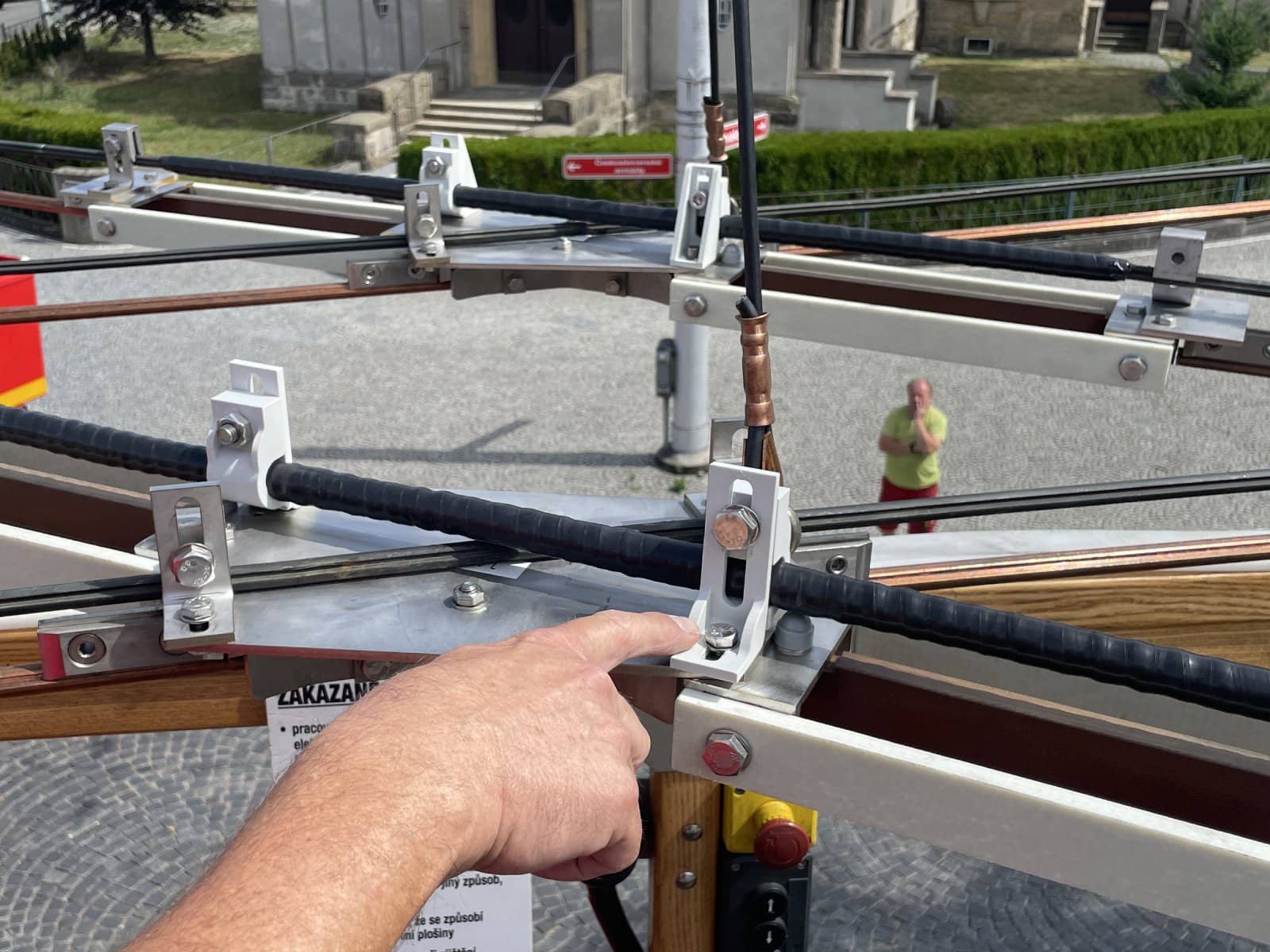
A 3D printer in the IT department does not just have to be used for producing small models and technical novelties. At the transit authority, it is now also becoming a tool for developing actual operational components. Cooperation between overhead line workers and IT has already brought several generations of prototype elements designed to help not only at overhead line crossing points. The advantages are the speed of development, the low cost of individual prototypes, and the ability to create a part tailored precisely to local needs.
The idea to use 3D printing came to Erik Jerie from the IT department from Jan Havlík. The overhead line workers have some special parts custom-made, and knowing that a 3D printer was available in the company, the question arose: couldn't at least some of them be produced directly here?
„Honza showed me a part, and I said it wouldn't be very difficult to draw it and create its model. He sent me a drawing with exact dimensions, I modeled it, and we started with the first test print,“ describes Erik Jerie.
And it was precisely the ability to quickly test one variant after another that proved to be one of the greatest advantages of the entire technology. For example, the first printed part was too flexible, so reinforcements were gradually added to the model. In the case of another component—a collar—several other versions were even created during the course of development. The dimensions, thickness, and overall strength were all changed.
„When they come and say they need to change the dimensions, I'm able to rework the model within half an hour,“ says Erik Jerie. First, a cheaper test prototype is printed to verify that all dimensions are correct. Only after it is tested does the printing from the material intended for the final component come into play.
Why plastic is an advantage in this case
The parts under development are used in locations where conductors of different polarities intersect on the overhead contact line. These must remain electrically and mechanically separated from each other. The conductor itself is therefore protected by insulation, while at the same time it is necessary to mechanically secure it at the given location.
„During various vibrations, for example when a pantograph drops or due to weather conditions, sharp stainless steel segments can gradually damage the insulation. That is why we came up with the idea of using 3D printing to create an insulating spacer that acts as a buffer zone between the mechanical attachment and the insulation,“ explains Jan Havlík.
This is precisely where 3D printing can have another advantage over a traditionally manufactured metal component. The plastic part can be designed with rounded edges, it can be more flexible, and there is no risk of insulation damage from a sharp edge in the same way. At the same time, it is not a structural part that needs to transfer large forces.
„We don't need high rigidity from it. It's not a structural element that holds something under force. Its main task is to maintain the required shape and position of the conductor, adds Havlík.
Article continues in magazine Dopravák.