


Home » News » Other news » The new Ford Ranger goes where heavy machinery cannot reach
The new Ford Ranger goes where heavy machinery cannot reach
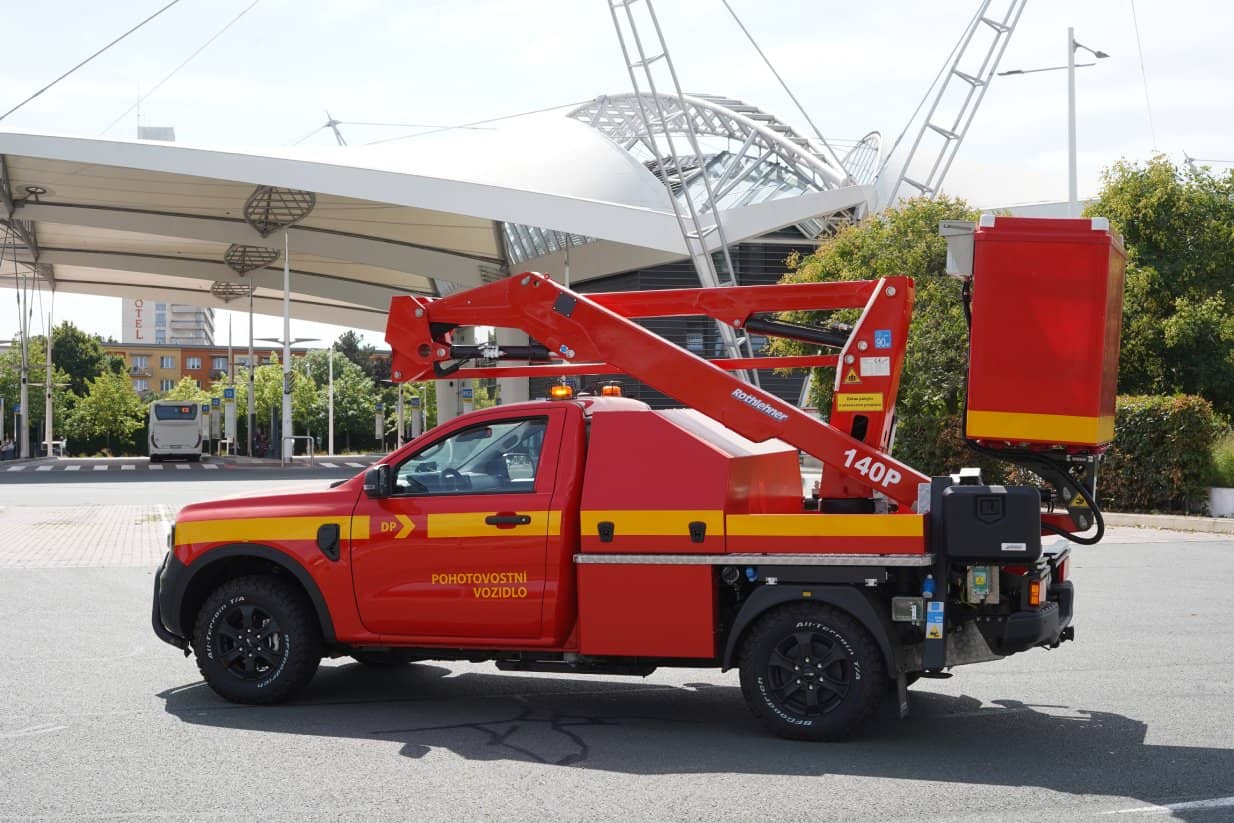
One vehicle, many tasks.
At first glance, it resembles an off-road pick-up truck. In reality, however, beneath the bodywork of the new Ford Ranger lies a technically exceptionally sophisticated utility vehicle built precisely to the requirements of the Hradec Králové Public Transport Company. The new aerial work platform can reach places where large trucks cannot, enables work on live overhead contact lines, and all of this with a group B driver's license. Thanks to a well-conceived energy system, it can operate while working without the diesel engine running and, with certain limitations, even without outriggers.
„The vehicle was ordered as a custom build from the very beginning. The original car was practically completely disassembled and rebuilt for our needs,“ explains Jan Havlík, who participated in the design of the technical solution.
From a standard pickup to a unique work vehicle
The basis of the new vehicle is the Ford Ranger. However, little of the original car remained during the conversion. The standard truck bed was removed and the vehicle received a new chassis with air suspension, a lowered center of gravity, a stabilization system, and a complete body with a lifting insulated platform.
The scope of modifications was so extensive that, according to Jan Havlík, approximately ninety percent of the vehicle was disassembled during production. At the same time, the supplier had not previously implemented such a demanding combination of technical requirements and considers the new vehicle to be one of its flagship products in the category of light truck-mounted platforms.
„In their own words, they had never had such a specific order before. Practically the entire design and technical layout of the vehicle, apart from the lifting device itself, was created specifically for us. There is no second identical piece at the moment,“ he adds.
The result is not merely a smaller replacement for a conventional aerial work platform. It is a standalone work system that combines off-road capability, electric drive for the superstructure, catenary maintenance operations, and the transport of equipment needed during breakdowns.
It drives on the road, sidewalk, grass, and even across a ditch
One of the main reasons for acquiring the vehicle was field experience. The overhead contact line is not located only above the roadway. Poles, suspensions, and other elements may stand on sidewalks, between railings and buildings, on grass areas, or off paved roads. A large flatbed truck often cannot fit into such places. Moreover, a heavy truck is generally not even allowed to drive onto sidewalks.
Article continues in magazine Dopravák.